Krill: Antarctica's Superfood
The size of a paper clip, pink, krill is a shrimp-like crustacean that does not look like much. Without them, though, the Earth marine ecosystems would collapse completely.
Euphausia superba: the Antarctic krill
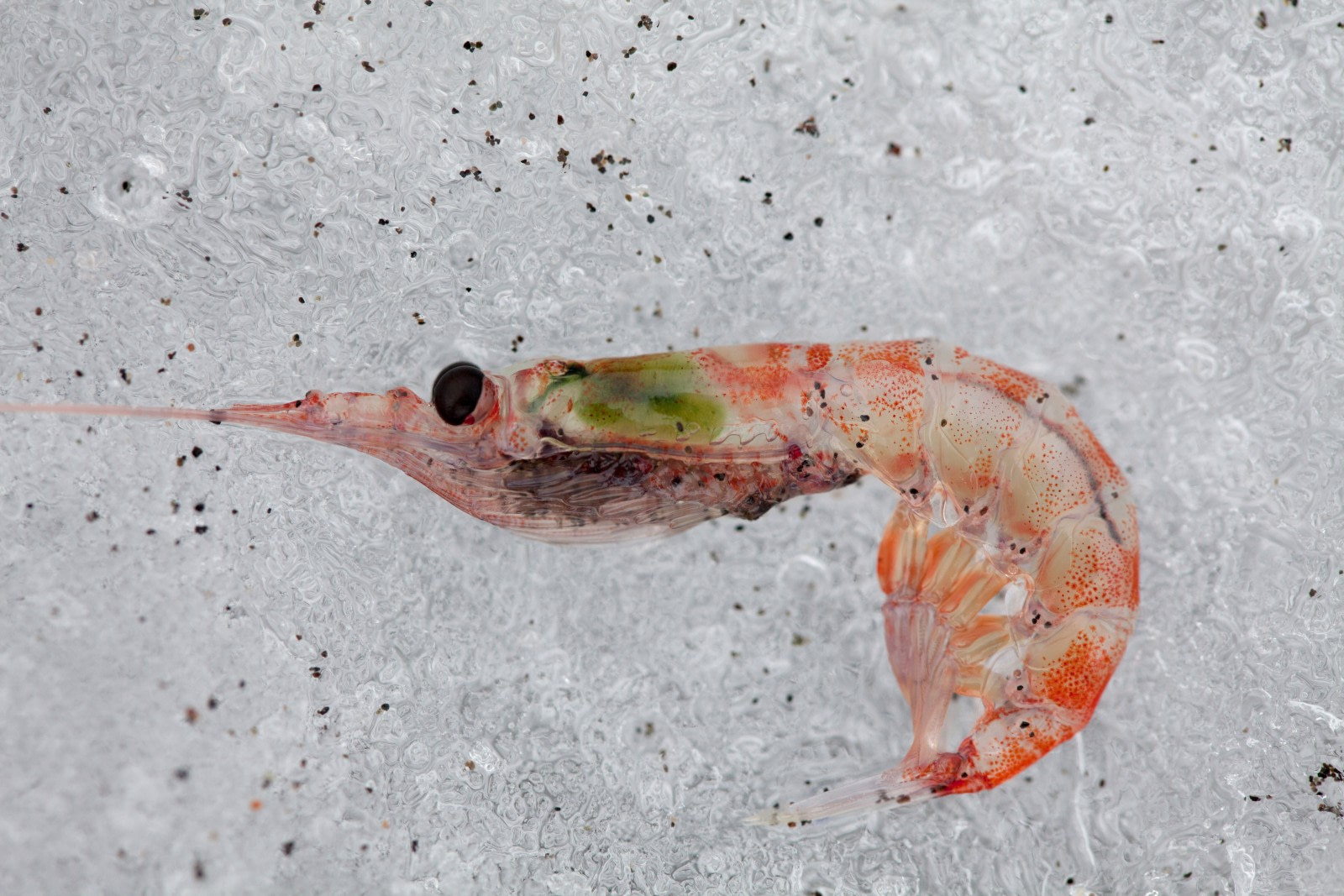
The Antarctic krill, Euphausia superba, are among the largest of the 85 known krill species and it can live up to ten years. They congregate in swarms in the cold waters around Antarctica, and their estimated numbers range from 125 million tons to 6 billion tons: the total weight of all the Antarctic krill is more than the total weight of all humans on Earth.
The body of Euphausia superba is about 2 inches long and translucent, with reddish brown blotches. The swimming larvae pass through nine stages of development. Males mature in about 22 months, females in about 25 months. During a spawning period of about five and a half months, the eggs are shed at a depth of about 740 feet. The krill larvae gradually move toward the surface as they develop, feeding on microscopic organisms. From January to April the swarms of krill in the Antarctic Ocean may reach concentrations of about 35 pounds per cubic yard.
Fundamental link in the food chain
The Antarctic krill are a fundamental link in the food chain: they are near the bottom, feeding mainly on phytoplankton and to a lesser extent zooplankton. They undertake large daily vertical migrations, providing food for predators near the surface at night and in deeper waters during the day. Half of all krill is eaten each year by whales, sea birds, seals, penguins, squid and fish, and it is quickly replaced by growth and reproduction. Watch some dramatic footage of humpback whales hunting krill in Antarctica.
The luminescent crustacean
When cruising in Antarctic waters, you might perceive a strange luminescence in the ocean. It's the krill swarms emitting light, produced by bioluminescent organs which are located in various parts of the individual krill's body: one pair of organs at the eyestalk, another pair on the hips of the second and seventh thoracopods, and singular organs on the four pleonsternites. These organs emit a yellow-green light periodically, for up to two or three seconds.
Antarctic krill fishing
Commercial krill fishing began in the early 1970s, and in 1981 a unique fishing treaty was signed: the Convention on the Conservation of Antarctic Marine Living Resources (CCAMLR), which is designed to protect the Antarctic ecosystem from the consequences of rapidly-expanding fisheries, and to aid recovery of the great whales and some of the overexploited species of fish. The CCAMLR is an international body which manages the krill fishing and sets limits on the krill catch taking into account the needs of other elements of the ecosystem. The total allowable catch for the southwest Atlantic is currently about 5.6 million tonnes annually.
The amazing nutritional properties of krill are not lost on humans. Krill are fished commercially mainly to produce animal food and fish bait, but there is a recent increase in the use of krill by the drug industry; they are also eaten in parts of Asia and used as an omega-3 supplement in the U.S. Pope Francis, for example, supplements his diet with krill oil supplements, a strong antioxidant rich in omega 3 fatty acid, and enriched with vitamin D3.